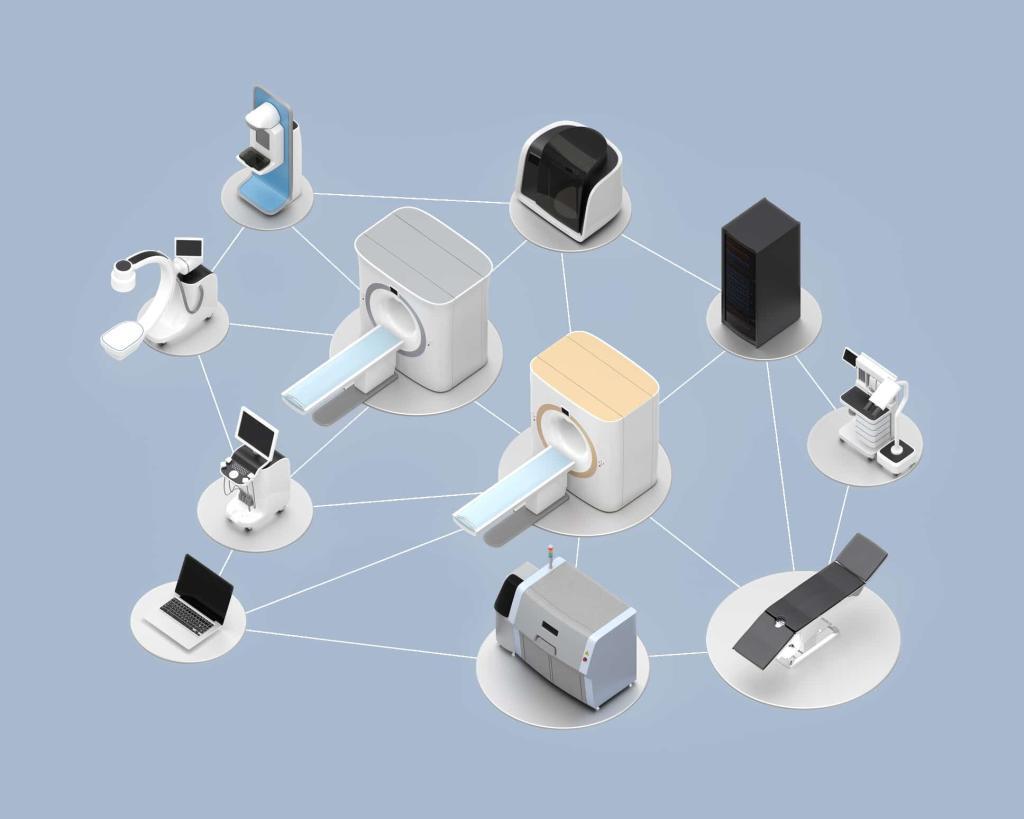


The Internet of Things in medicine has long ceased to be a mere curiosity for pilot projects: room sensors, wearable devices, smart pumps, oxygen and blood pressure monitoring systems—all of this is now present in the patient’s environment and has a real impact on clinical decisions. When a healthcare iot company implements such solutions, the focus quickly shifts from the gadget’s design to the sensor’s accuracy, to the entire system’s ability to seamlessly exchange data with the hospital infrastructure. Interoperability in the Healthcare IoT is about ensuring that data isn’t simply collected, but correctly delivered to where it can be used by doctors, nurses, and labs, without loss, distortion, or chaos.
Why Interoperability in Medicine Isn’t a ‘Nice Perk’
In a typical digital environment, incompatibility often means inconvenience. In medicine, it means risk. When monitors, wearables, and hospital systems are separate, the patient receives a fragmented observation history. The doctor sees only part of the picture, and time is wasted on manual verification, calls, downloads, and repeated measurements.
Interoperability isn’t just important for beautiful dashboards. It directly impacts:
- speed of clinical decision making;
- quality of documentation and continuity of treatment;
- patient safety (errors due to incorrect or incomplete data);
- the burden on staff who are already working under time pressure.
Where exactly does the “common language” of devices and systems break down?
The problem is rarely localized. It’s usually a chain: device → gateway/mobile app → cloud → EHR/EMR integration → physician workstation → analytics/quality.
The most typical “breakdowns” look like this.
Different standards and data formats
Even if two devices measure the same thing, they may describe it differently: units of measurement, frequency, timestamps, patient identifiers, measurement context (at rest, after exercise, during sleep). As a result, data is difficult to compare—and sometimes it cannot be safely combined at all.
In practice, a mixture of approaches is most often encountered:
- “producers’ own” formats (quick start, poor scalability);
- standards for the exchange of medical data (FHIR, HL7, DICOM – depending on the type of data and place in the process);
- “technical” communication protocols (BLE, Wi-Fi, MQTT, etc.) that help transmit data but are not responsible for its clinical meaning.
Patient identification and measurement linkage
Medicine isn’t about abstract graphs. It’s important that specific data belongs to a specific patient and a specific episode of treatment. But in reality, situations arise: a device is connected “during a shift,” a patient is transferred to a different department, a bracelet/ID card is changed, or a bed in a ward is changed. If the “patient-device-event” connection is poorly constructed, dangerous scenarios arise when data ends up in the wrong record or loses context.
Time and synchronization
It sounds trivial, but this is one of the most annoying causes of “invisible” errors. Devices can operate in different time zones, experience time drift, and mark the start and end of events differently. For a doctor, this manifests itself simply: strange dips in the graph, events overlap, and alarms are triggered retroactively.
To make data clinically useful, discipline is required:
- single time source (NTP and control);
- correct timestamps with the accuracy required in a given scenario;
- logic for handling delays and “batch” delivery (when data arrives later due to connection).
Why doesn’t “plug it in and it works” happen in hospitals?
Many people imagine implementation like this: install sensors, connect to Wi-Fi, and the data starts flowing. In reality, a hospital is an environment with special restrictions.
Network and infrastructure: instability is the norm
Departments often have shielding, “dead zones,” overloaded Wi-Fi, strict security policies, and network segmentation. Devices can periodically “disconnect,” and their reconnection must be secure and transparent. If the system can’t cope with these conditions, it becomes a permanent “manual” project, with medical staff forced to act as IT support.
Old systems and “complex legacy”
At many healthcare institutions, EHR/EMR and supporting systems have been developing for years. These systems may have limitations regarding interfaces, licenses, exchange rates, and storage rules. Sometimes integration is only possible through an intermediate layer or strictly according to specific data profiles. That’s why interoperability isn’t about “creating a single API,” but rather about the ability to seamlessly integrate into an existing ecosystem.
Security and privacy as part of interoperability
A common mistake is to treat security as a separate, post-development step. In Healthcare IoT, security is built into the data exchange itself. If you have integrations, you have entry points, access rights, keys, roles, and event logs.
What usually becomes a stumbling block:
- different approaches to authentication and authorization (who can read/write what);
- data storage and transmission (encryption, keys, rotation);
- device management (updates, inventory, remote shutdown);
- logging and auditing (who accessed what and what they did).
For a medical website, it’s important to emphasize that interoperability without access control and transparent auditing creates clinical and legal risks. If patient data “moves” between systems, it must be clear where it is located, who has accessed it, and how its integrity is ensured.
Practical “symptoms” of poor compatibility that a doctor sees
To avoid leaving the topic purely technical, it’s useful to list the signs that are evident in the clinic’s work:
- nurses manually copy the readings from the device into the chart;
- the doctor doesn’t trust the charts because the readings “jump” and it’s not clear why;
- worries come too often or, on the contrary, important events are missed;
- the same parameter has different values in different systems;
- Each device requires a separate login, application, or “board” with instructions.
If you see even a couple of these signals, the problem is usually interoperability: the data is not standardized, not cleaned, not associated with the patient, or not flowing through the correct route.
How to approach the solution: not “everything at once,” but clinical scenarios
The most effective approach is to start with specific scenarios and decision chains. For example: “postoperative respiratory monitoring,” “home glucose monitoring for patients,” “heart rate monitoring in the cardiology department.”
Within the scenario, it is important to describe in advance what data is actually needed and how it will be used:
- where this data should appear (in the EHR, at the post, in the telemedicine office);
- what thresholds and alarms are clinically justified;
- who confirms the accuracy of the data;
- what is considered an “error” and how the system should behave.
And standards, interfaces, and integration architecture are selected based on this.
A short checklist for the clinic and implementation team
To prevent compatibility from becoming a never-ending chore, it’s helpful to keep a few questions in mind. They sound simple, but they can often save months.
- What systems will be the source of “truth” for the patient, appointments, and events?
- How does the device know which patient it is assigned to, and what happens when a patient is transferred?
- Where and how are units of measurement, timestamps, and context normalized?
- What happens when connection is lost: buffering, resending, delay marks?
- How are access, auditing, and device management organized throughout the lifecycle?
This is not a “project plan,” but a set of common sense questions that must be addressed before IoT becomes part of everyday clinical practice.
Bottom line: Interoperability is about clinical reliability, not just IT integration
The healthcare IoT has the potential to bring greater transparency, early warning, and continuous monitoring to medicine. But only on one condition: the data must be compatible, understandable, and integrated into the clinical workflow in a way that reduces, rather than increases, the workload.
Interoperability is when devices, systems, and commands work as a single mechanism: measurement turns into a reliable record, record into action, and action into improved patient care. This is when smart sensors truly become medical tools, not just another source of data.
Disclaimer
The information presented in Interoperability Challenges in Healthcare IoT by Open MedScience is provided for general informational and educational purposes only. It does not constitute medical, clinical, technical, regulatory, cybersecurity, legal, or professional advice.
While every effort has been made to ensure accuracy at the time of publication, the content reflects general industry observations and conceptual discussion rather than specific guidance tailored to any particular healthcare organisation, infrastructure, vendor platform, or regulatory jurisdiction. Healthcare institutions, technology providers, and implementation teams should conduct independent technical assessments and seek qualified professional advice before making procurement, integration, cybersecurity, or clinical workflow decisions.
References to standards, including HL7, FHIR, DICOM, and various communication protocols, are provided for contextual discussion only and do not imply endorsement, certification, or compliance with any specific framework. Regulatory requirements, data protection obligations, and interoperability standards may vary by country and may change over time.
Open MedScience does not assume responsibility for any loss, damage, clinical incident, regulatory consequence, or operational disruption arising from reliance on the information contained in this article. Implementation of Healthcare IoT systems must be undertaken in accordance with applicable laws, institutional governance policies, cybersecurity best practice, and clinical risk management procedures.
Views expressed in this article are those of the author and do not necessarily reflect the official policy or position of any healthcare institution, manufacturer, standards body, or regulatory authority.
Readers are encouraged to consult appropriate clinical, technical, cybersecurity, and legal professionals before implementing or modifying Healthcare IoT solutions.
home » blog » medical technologies »