
Most of your skin isn’t skin cells. Most of a tendon isn’t tendon cells. In a lot of the tissue holding you together, the cells are a minority tenant, and the bulk of the material is the mesh they’re sitting in.
For most of the twentieth century, biologists treated that mesh as packing material. Structural filler. The interesting things happened inside cells, and the stuff between them just held everything in place.
That view has shifted. Researchers now describe the extracellular matrix, or ECM, as an active participant in what cells do, a network that sends information as well as providing support. And that reframing has opened up a research lane into whether certain small peptides, including copper-binding compounds like GHK-Cu, interact with that network.
Worth saying clearly up front: this is early-stage laboratory science, not medicine. None of the compounds discussed here are approved treatments for anything, and nothing below is health advice.
What the extracellular matrix actually is
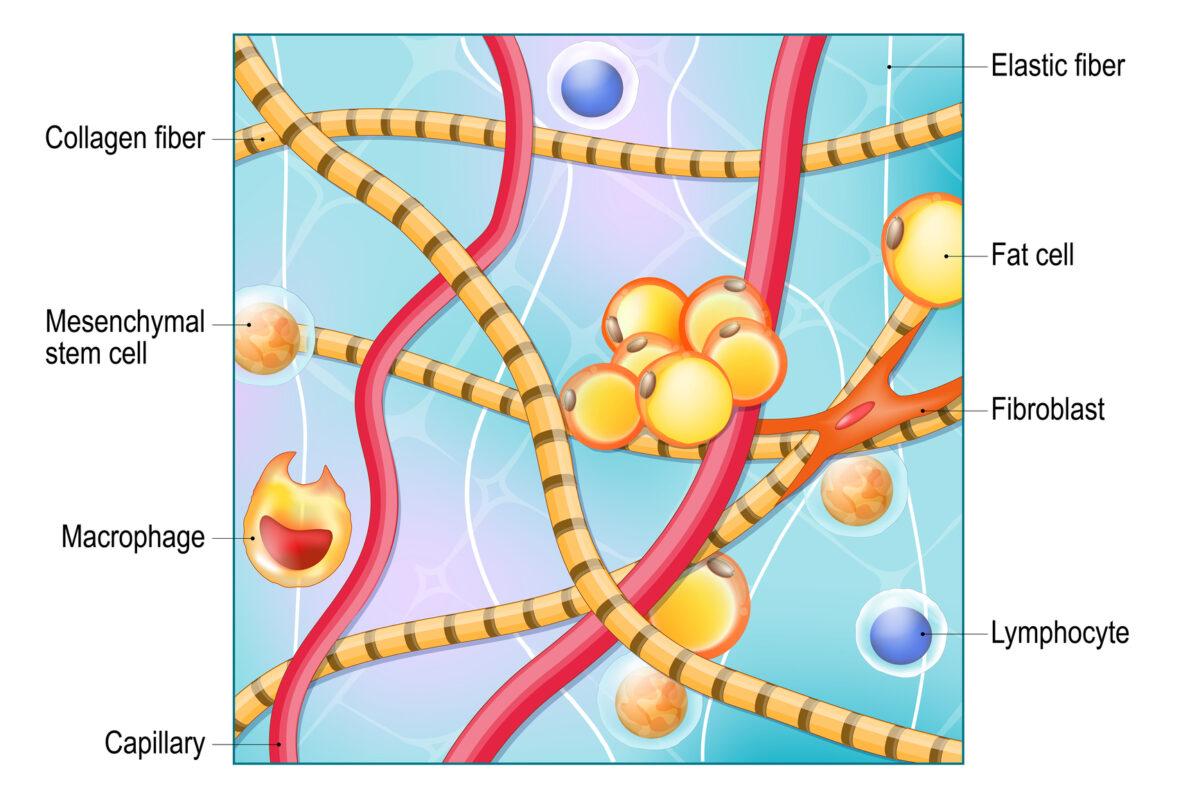
The ECM is the non-cellular material that surrounds cells in tissue. It’s built largely from collagen, elastin, and a group of sugar-and-protein molecules called proteoglycans and glycosaminoglycans, woven into a mesh that gives tissue its mechanical character. It’s the reason cartilage is springy, skin is elastic, and tendon resists being pulled apart.
The part researchers have come to appreciate more recently is that this mesh isn’t finished. It’s constantly being built, dismantled, and rebuilt, and the state it’s in appears to carry information that cells respond to.
How a scaffold sends a signal
Cells don’t just sit in the matrix. They read it.
Proteins called integrins run through the cell membrane and physically link the cell’s internal skeleton to the matrix outside it. That connection lets mechanical and chemical information from the surrounding mesh get translated into activity inside the cell. Researchers sometimes call this outside-in signalling, to distinguish it from the more familiar picture where a hormone arrives via the bloodstream and docks onto a receptor.
Two things make this more than a technicality.
The first is that the physical properties of the matrix seem to matter. In laboratory models, how stiff or how structured the surrounding matrix is can influence a cell’s shape, how it moves, and in some cases what type of cell it becomes.
The second involves what happens when the matrix breaks down. Enzymes called matrix metalloproteinases chew up collagen and other matrix proteins as part of normal tissue turnover, and that process releases small protein fragments. Some of those fragments, known in the literature as matrikines, appear to act as signalling molecules in their own right, doing something different from the larger protein they were cut from.
That’s the finding that made small peptides interesting here. If the body already generates short peptide fragments that carry instructions, then short peptides as a category become worth investigating.
GHK-Cu, and what the research has actually looked at
Glycyl-L-histidyl-L-lysine is a tripeptide, meaning a chain of just three amino acids. It binds copper, and in that bound form it’s usually written as GHK-Cu. It occurs naturally in human plasma, where it was first identified.
It’s become one of the more heavily studied compounds in copper peptide research, partly because copper itself is a cofactor for several enzymes involved in connective tissue biology, including lysyl oxidase, the enzyme that cross-links collagen and elastin fibres into a stable network.
The published laboratory work clusters around a few themes:
- Fibroblast studies, examining whether GHK-Cu affects the activity of genes tied to collagen and elastin production, often looking at TGF-beta, a signalling pathway involved in tissue building.
- Gene expression surveys, using large databases to map which genes shift in the compound’s presence. Useful for generating hypotheses, but this kind of broad correlation work needs targeted follow-up before anyone can claim a mechanism.
- Animal wound models, measuring things like collagen deposition and tissue formation during healing. Informative, but findings in animal tissue don’t establish what happens in humans.
- Copper chemistry, a separate thread looking at how the peptide binds and delivers copper, given that metal’s enzymatic role.
The part that needs saying plainly
Here’s the current state of the evidence, and it matters more than any individual finding above.
Almost all of this work comes from cells in culture dishes and animal models. Controlled human trial data is limited. That gap isn’t a technicality; it’s the difference between “this does something interesting in a dish” and “this does something useful in a person,” and a lot of compounds have cleared the first bar and failed the second.
There’s a second issue specific to this compound. A meaningful share of the GHK-Cu literature traces back to a fairly concentrated set of research groups, with the original discovery and much of the early characterisation coming from work by Loren Pickart. That doesn’t make the findings wrong. It does mean the field would benefit from replication by laboratories with no connection to that original work, which is the normal way science firms up a result.
Beyond that, published studies vary widely in concentration, delivery method, and formulation, which makes comparing them to each other genuinely difficult.
Why researchers keep looking anyway
The matrix sits at the centre of processes people care about: how wounds close, how connective tissue holds up, what changes in tissue structure as we age. If a compound can be shown under controlled conditions to shift the balance between matrix construction and matrix breakdown, that’s a useful handle on all of those questions.
What better evidence would look like
Researchers have identified several areas that could strengthen the evidence base.
Moving from flat, two-dimensional cell cultures toward three-dimensional tissue models that better mimic real matrix architecture. Pairing gene-expression data with protein-level and functional measurements, rather than treating a change in gene activity as the end of the story. And running head-to-head comparisons against other matrix-active peptides, to work out which effects belong to this specific compound and which are shared across the whole class.
None of that is glamorous. All of it is what turns a promising single-lab finding into something the wider field accepts.
The takeaway
The reframing of the extracellular matrix, from inert scaffolding into an active part of how cells communicate, is a real and interesting shift in cell biology. It has opened up genuine questions about whether small peptides like GHK-Cu interact with matrix-related gene activity.
But the evidence sitting behind those questions is preclinical, concentrated in cell culture and animal work, and still waiting on broader independent replication. This is an active area of inquiry, not settled science, and none of it should be read as a health claim or a treatment recommendation.
Frequently Asked Questions
What does extracellular matrix signalling mean in plain terms? It refers to the way the structural material around cells, built from proteins like collagen and elastin, sends chemical and mechanical information back to those cells, instead of just holding them in place.
Is GHK-Cu approved for medical use? No. It’s studied in laboratory and preclinical settings. It is not an approved medical treatment, and the research described here is not a clinical recommendation.
What is a matrikine? A peptide fragment released when enzymes break down matrix proteins during normal tissue turnover. Some appear to act as signalling molecules themselves, separate from the protein they came from.
Why does copper come up in matrix research? Copper is a required cofactor for several enzymes in connective tissue biology, including ones that cross-link collagen and elastin. That’s part of why copper-binding peptides have drawn attention.
How solid is the current GHK-Cu research? Most of it comes from cell culture and animal studies, with a notable share originating from a relatively small group of labs. Broader independent replication is still needed before the findings can be treated as established.
Disclaimer
This article is provided for educational and informational purposes only and is not intended as medical, clinical, or scientific advice. It discusses published research relating to the extracellular matrix (ECM), cell signalling, and the peptide GHK-Cu, much of which is based on laboratory, cell culture, and animal studies rather than established clinical evidence in humans. The inclusion of GHK-Cu or any other compound does not imply that it is safe, effective, approved, or recommended for the prevention, diagnosis, or treatment of any medical condition. Readers should not interpret the information presented as a health claim, therapeutic recommendation, or endorsement of any product, supplement, or research chemical. While every effort has been made to present accurate and balanced information based on available scientific literature at the time of publication, research in this field is evolving, and conclusions may change as new evidence emerges. Readers should consult qualified healthcare professionals before making decisions about their health or medical care. Open MedScience does not manufacture, sell, or endorse GHK-Cu or related products and accepts no liability for any actions taken based on the information contained in this article.